

Storm Pipe Repair for a Town Built Around Ditches, Culverts, and Low Ground
Drainage works differently than it does in a dense suburb. Water moves through roadside ditches, crosses under driveways and roads in culverts, and makes its way toward creeks and marsh. When one of those pipes starts failing, the first sign is usually water that won’t move: a ditch that stays full, a yard that floods upstream of a crossing, or a hole opening up beside a pipe end.
Palmetto Pipe Lining offers large diameter CIPP stormwater pipe lining in Hollywood, SC. We line large storm sewers and culverts from the inside, so the road, parking lot, or lawn above them doesn’t have to be dug up to fix them.
Call us at (843) 905-3367 to request a pipe evaluation.
Call (843) 905 3367
Schedule Service
Where Is Stormwater Pipe Hiding on Your Property?
In a rural area, storm pipes are easy to overlook because so much of it sits at the edges of a property. Common places we find them in and around Hollywood include:
Ownership varies. A culvert under a private entrance is often the property owner’s responsibility, while pipes under public roads usually belong to a public agency.
What Does a Failing Storm Pipe Look Like From Above Ground?
You’ll usually see the damage around the pipe before you see the pipe itself. Things we look for in the field:
Each of these points to a different kind of failure, which is why we put a camera in the pipe before suggesting a fix.
What’s Usually Wrong Inside the Pipe?
Rusted-Out Metal Culverts
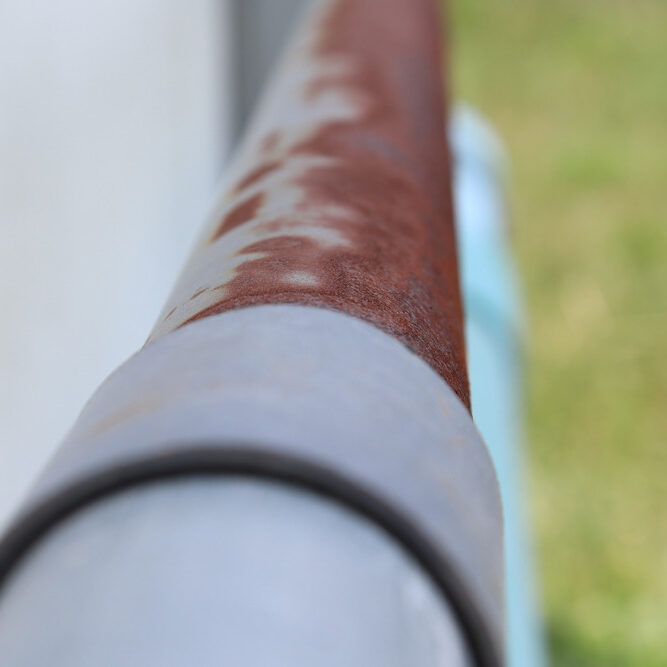
Corrugated metal pipe has been widely used for culverts and cross-drains. The bottom of the pipe stays wet the longest, so that’s where rust usually breaks through first. Once the invert is gone, water travels underneath the pipe instead of through it.
Concrete Joints That Let Soil In
Concrete storm pipe is laid in sections. When a joint opens, surrounding soil can wash into the pipe during each storm. Over many storms, that creates an empty pocket around the pipe, and eventually the ground above it gives way.
Ends Buried in Sediment and Growth
Pipe ends in ditches collect sediment, leaves, and vegetation. A partly buried outlet restricts flow even when the rest of the pipe is in decent shape.
How Do Weather and Tide Shape the Schedule?
A liner needs a controlled pipe while it’s installed and cured, so we plan the work for dry stretches and keep an eye on the forecast. Near the creeks and marsh around Hollywood, some outfalls also sit low enough that water levels change with the tide.
Where that’s the case, we factor the tide into when the work happens, since a pipe that fills from its outlet end needs the same planning as one carrying runoff.
What Happens When We Line a Storm Pipe?
The pipe gets cleaned first. Sediment, roots, and debris come out so the liner can bond to the old pipe wall. Any water still moving through the line is controlled for the duration of the work.
Next, we feed a resin-saturated liner through an inlet, manhole, or pipe end. Once it’s in position, the resin cures into a rigid, jointless pipe inside the old one. Connections tied into the line are reopened, and we run the camera again so you have footage of the finished liner.
Because many of these pipes drain toward ditches, ponds, and marshes, we plan installation and curing with the outlet in mind.
When Does a Storm Pipe Need More Than a Liner?
A liner depends on the old pipe for its shape. If a culvert has collapsed, if the bottom has rusted away along a long stretch, or if a large void has formed around the pipe, lining alone may not hold up. Erosion at the outlet is a separate problem, too. A liner fixes the inside of the pipe, but it doesn’t rebuild a washed-out ditch bank or a damaged headwall. If the inspection shows any of these, we’ll tell you plainly and talk through what that part of the job needs.
Reasons Why Hollywood Trusts Us With Their Storm Pipes
Frequently Asked Questions
It depends on where the pipe sits and who installed it. Culverts under private entrances are often the owner’s responsibility, so check your plat or ask the local road authority if you’re unsure.
Usually, once the end is cleared enough to get a camera inside. Clearing a buried outlet often reveals a lot about how the pipe has been performing.
No. Lining repairs the inside of the pipe, and outlet erosion has to be dealt with separately.
Often, yes, if the pipe is still sound enough to serve as a host. Lining from the pipe ends can keep the lane usable during the work.
That depends on how quickly the pipe drains down and what the forecast looks like. We pick a window once the line is calm enough to work in.
Request a Pipe Evaluation
That full ditch or soft spot beside a culvert is telling you something about the pipe underneath. We’ll get a camera into the line and show you what’s going on. Call us at (843) 905-3367 to request a pipe evaluation for large-diameter CIPP storm sewer and stormwater lining in Hollywood, SC.